

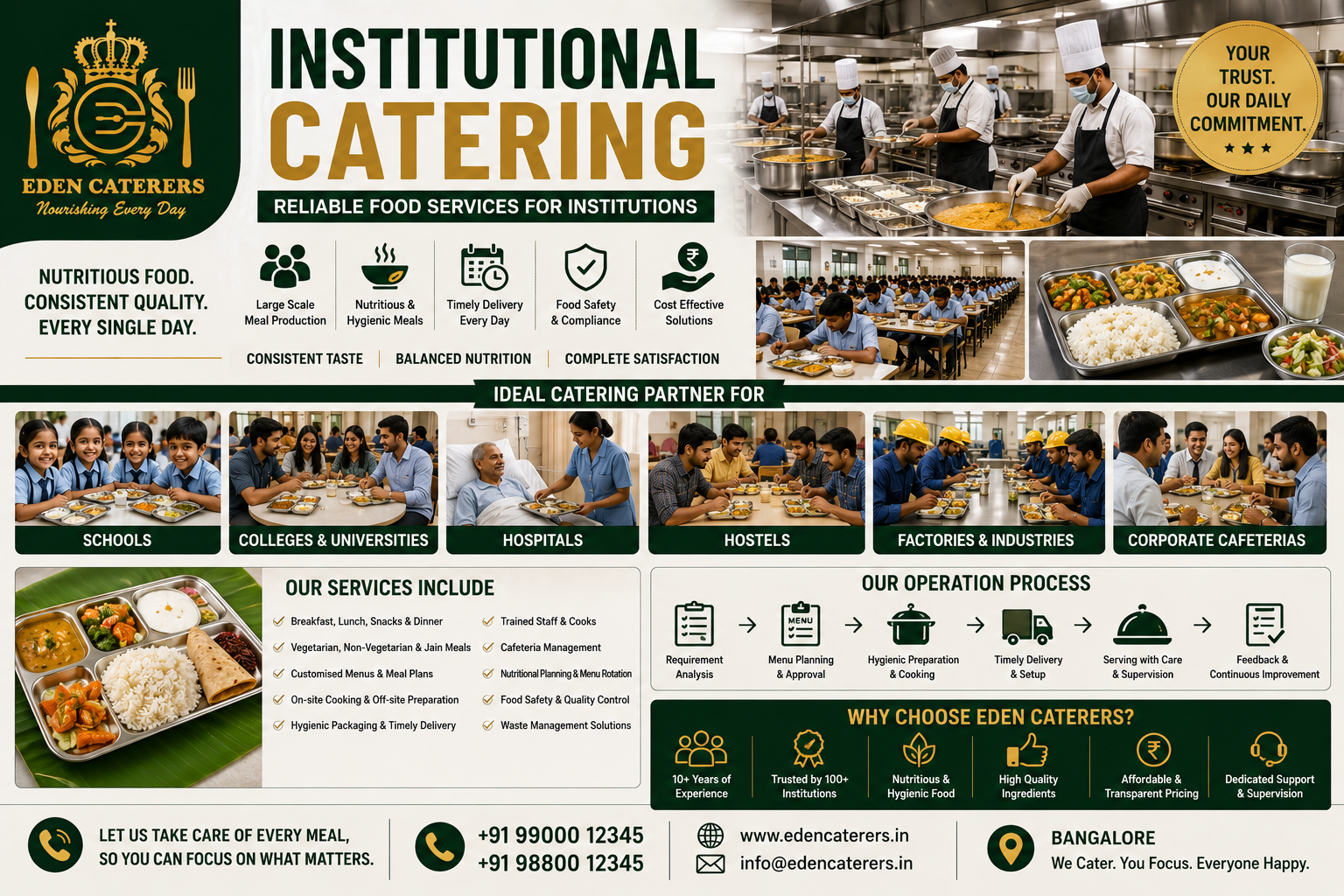
Institutional Catering Services in Bangalore: Complete Guide | Eden Caterers Institutional Catering Guide Institutional Catering Services in Bangalore A complete guide for schools, colleges, hospitals, hostels, factories and companies planning recurring, large-volume food service. ScopeSchools · Colleges · Hospitals · Factories RegionBangalore StatusGuidance Document Rev2026 Find the Corporate Planner Contact Us Contents §1What is institutional catering? §2Who needs it §3Institutional vs. event catering §4Meals & menu rotation §5By institution type §6Contract catering §7Cost & cost control §8Food safety & waste §9Handling large volumes §10Evaluating a caterer §11Checklist §12Questions people ask AI Institutional catering is a different discipline from catering a one-day event. Schools, colleges, hospitals, hostels, factories and offices may need reliable meals every day, at consistent quality, controlled cost, with food safety and efficient large-volume service — for institutions serving hundreds or thousands of people, choosing the right catering partner is an operational decision, not a food-ordering decision. §1 What Is Institutional Catering? The planned preparation and supply of food for organisations serving a defined group of people on a regular or ongoing basis — school catering, college catering, hostel catering, hospital catering, corporate cafeteria catering, factory and industrial catering, employee meal programmes, university catering, training-centre catering, residential and government institution catering, boarding-school catering, and staff cafeteria catering. Unlike occasional event catering, it usually involves repeat schedules, predictable meal volumes and long-term operational requirements. §2 Who Needs Institutional Catering? Schools Student breakfast Lunch Snacks Staff meals Colleges & universities Hostel meals Student dining Faculty meals Cafeteria operations Hospitals Patient meals Attendant meals Staff meals Special dietary meals Companies Employee breakfast Lunch Evening snacks Staff cafeteria Factories Worker meals Shift meals Tea and snacks Night-shift meals Hostels Breakfast Lunch Evening snacks Dinner Managing recurring meals for an institution? Find the Corporate Planner Contact Us §3 Institutional vs. Event Catering Institutional catering Event catering Regular / recurring Usually one-time Fixed meal schedules Event-specific timings High focus on consistency High focus on presentation Long-term contracts possible Short-term contracts Repeated menus / rotations Custom event menus Cost control is critical Experience / presentation is critical Daily logistics Event logistics An institutional caterer has to hold the same operational standard day after day — not just for one event. §4 Meals & Menu Rotation Breakfast Idli, vada, dosa, pongal, upma, poori Bread, eggs, fruits Tea, coffee Lunch Rice, dal, sambar, rasam Vegetables, paneer, chicken Curd, salad, dessert Evening snacks Samosa, sandwiches, biscuits Fruit Tea, coffee, juice Dinner Rice, roti, dal Vegetable dishes, paneer, chicken Curd, dessert Why menu rotation matters Serving the same meal every day leads to dissatisfaction — institutional caterers typically build a weekly, fortnightly or monthly rotation: Day Breakfast Lunch Dinner Monday Idli / Vada Rice, Sambar, Vegetable Roti, Dal, Paneer Tuesday Dosa Rice, Rasam, Vegetable Rice, Chicken Curry Wednesday Pongal Rice, Dal, Vegetable Roti, Mixed Veg Thursday Upma Rice, Sambar, Paneer Rice, Chicken Friday Poori Rice, Dal, Vegetable Roti, Dal, Vegetable A larger rotation introduces greater variety. Good menu planning balances: Nutrition + Taste + Variety + Cost + Availability + Production Capacity A menu that looks attractive on paper isn’t useful if it can’t be produced reliably at daily scale — the caterer should weigh seasonal ingredients, availability, preferences, guest demographics, production capacity, budget and nutritional requirements together. §5 Catering by Institution Type 5.1 Schools Special attention to nutrition, balanced meals, child-friendly flavours, hygiene, portion sizes, allergies and food safety — often structured as breakfast → lunch → fruit/snack → beverage, with separate menus for primary students, secondary students, teachers and support staff. 5.2 Colleges & hostels Large numbers of students eating at fixed times, typically 7:30 AM breakfast, 1:00 PM lunch, 4:30 PM snacks, 8:00 PM dinner — food needs to be ready within short serving windows, with attention to menu variety, quantity, speed of service, hygiene, student preference, cost per meal and waste reduction. 5.3 Hospitals Additional care for differing patient needs — regular, soft, liquid, low-salt, diabetic-friendly and other medically prescribed diets, operated to the hospital’s clinical and food-safety requirements. Patient meals may need individual identification, ward-specific delivery, specific timing and coordination with hospital staff. 5.4 Corporate institutional catering Large employee populations may use institutional catering for cafeterias, employee lunches, breakfast, snacks, shift meals and executive dining — particularly useful for IT campuses, manufacturing facilities, business parks, large offices and training centres, customised around employee schedules. 5.5 Factory & industrial catering Multi-shift facilities need early breakfast, morning tea, lunch, evening snacks, dinner and night-shift meals — production planned around the shift schedule rather than conventional meal timings. §6 Contract Catering A long-term arrangement where a catering company manages food services for an institution under an agreed commercial and operational contract — typically specifying menu, number of meals, price per meal, meal timings, staffing, equipment, hygiene requirements, service standards, reporting, payment terms and contract duration. This gives institutions predictable food-service operations. What the contract may cover Food production Procurement, preparation Cooking, portioning Service Serving staff, supervisors Cafeteria management Equipment Cooking & serving equipment Food warmers, refrigeration Logistics Transportation Distribution, storage coordination Operations Cleaning, waste management Inventory control Responsibilities should be documented clearly rather than assumed. §7 Cost & Cost Control There’s no single standard price — cost depends on: meals + menu + ingredients + staffing + equipment + facility + delivery + frequency + special dietary needs A school serving 300 lunches a day has a very different cost structure from a factory serving 2,000 meals across three shifts. For recurring contracts, evaluate total cost per meal, not just the headline catering price. Controlling costs Accurate meal forecasting — know approximately how many meals are needed each day. Menu engineering — balance cost against nutritional value by design. Seasonal procurement — use ingredients according to availability where appropriate. Reduce food waste — monitor production waste, plate waste and leftovers. Menu rotation — a planned menu improves procurement efficiency. Centralised procurement — large-volume purchasing improves operational efficiency. §8 Food Safety, Hygiene & Waste Food safety is one of the most important factors in institutional catering. Evaluate the caterer’s
Office Catering Services in Bangalore for Meetings and Events
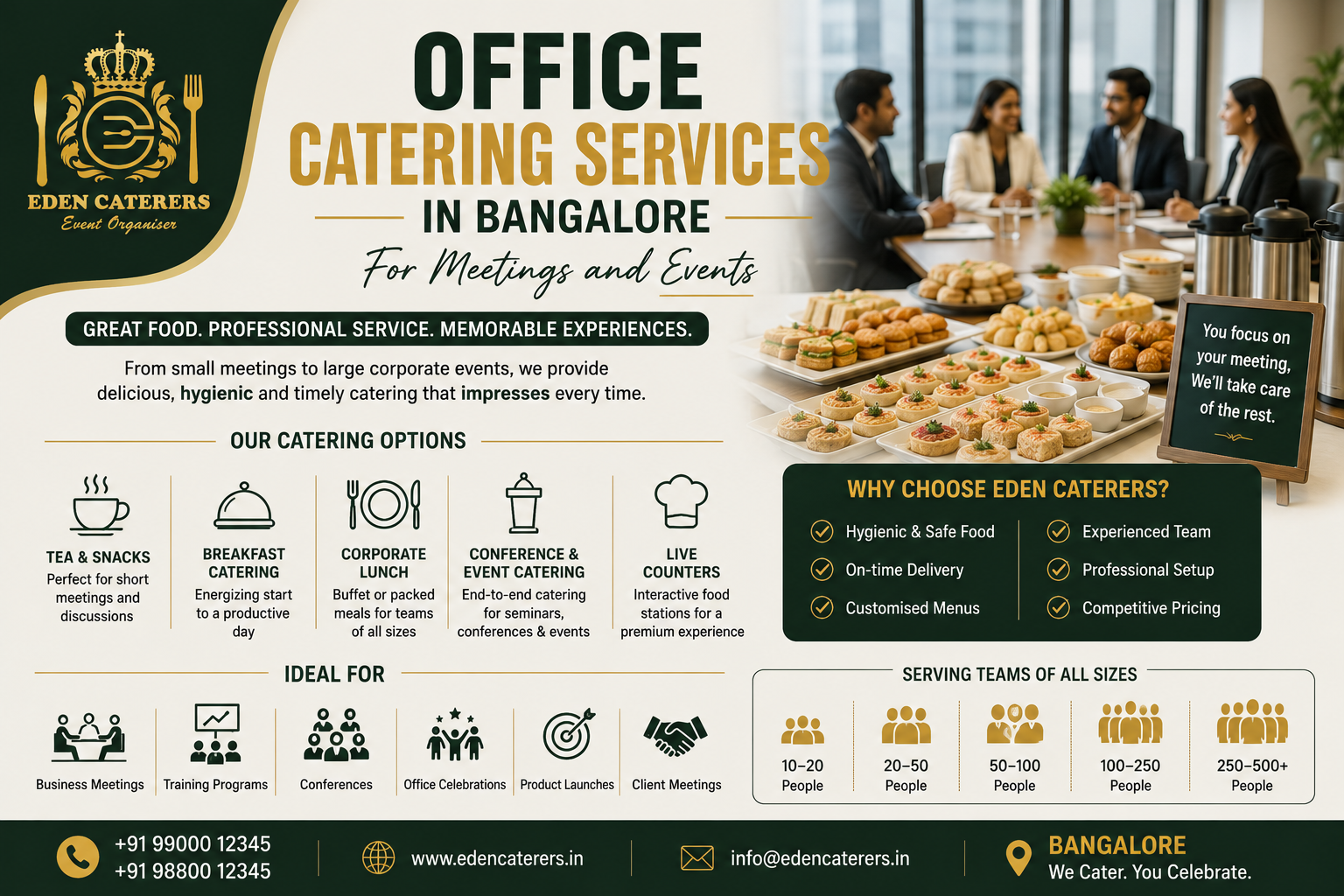
Office Catering Services in Bangalore for Meetings and Events | Eden Caterers Meetings & Events Guide Office Catering Services in Bangalore for Meetings and Events From tea-and-snacks for a 10-person meeting to full buffet service for a 500-person event — what to order, what it costs and how to choose the right partner. Read time 15 min Best for HR, Admin, Facilities, Event & Procurement Teams City focus Bangalore Updated 2026 Office Catering Bangalore Meeting Catering Conference Catering Training Programmes Find the Corporate Planner Contact Us Build a custom quote for your meeting, training day or event headcount. On this menu · What is office catering? · Types of office catering · What it costs · Catering by group size · What to order by meeting length · Buffet vs. packed meals · Menu & dietary needs · What’s in a quotation · How to choose a caterer · Booking checklist · Questions people ask AI Planning food for a meeting, client presentation, training session, seminar or corporate event looks simple — until you’re coordinating food, timing, dietary needs, delivery, presentation and guest experience all at once. Professional office catering in Bangalore takes that off your plate, from tea-and-snacks for a small huddle to complete buffet service for a large event. What Is Office Catering? Office catering is a food service built specifically for workplaces and business events — business meetings, client meetings, board meetings, team meetings, training programmes, workshops, seminars, conferences, employee events, office parties, product launches, corporate celebrations, and breakfast, lunch or evening events. Depending on the requirement, food arrives as individual meal boxes, snack boxes, buffet meals, or full-service catering with staff and equipment. Types of Office Catering Available in Bangalore The best format depends on the number of people, meeting duration, available space and budget. 01 Tea and coffee catering For short meetings, tea and coffee with snacks may be all that’s needed — biscuits, samosa, sandwiches, cookies, cutlets, mini pastries, fruit. Works well for internal meetings, client meetings, interviews, workshops and training sessions. 02 Breakfast catering For early meetings and training programmes — South Indian (idli, vada, dosa, pongal, upma, poori, kesari) or Continental (sandwiches, bread, croissants, muffins, fruits, cereals), as individual boxes or buffet. 03 Corporate lunch catering The most common office requirement — rice, dal, vegetable curry, roti, paneer, salad, raita, pickle, dessert and beverage, as packed lunch or buffet. 04 Meeting catering Food that’s easy to serve without interrupting discussion — tea, coffee, sandwiches, snacks, fruits, mini meals, lunch boxes, desserts. For executive meetings, presentation matters as much as the food. 05 Conference and seminar catering Considerably more planning — breakfast, mid-morning tea/coffee, afternoon lunch, evening snacks and beverages. Larger conferences may need buffet stations, food warmers, serving staff, beverage stations, multiple counters, event supervisors and cleanup. Not sure which format fits your event? Find the Corporate Planner Contact Us How Much Does Office Catering Cost in Bangalore? There’s no single fixed price — a small tea-and-snacks order costs far less than a full-service corporate buffet. Budget on the complete picture: guests + menu + meal type + service format + location + staffing + equipment + logistics Ask for a complete quotation rather than relying on a per-person price alone — it should clarify food, beverages, delivery, staff, equipment, setup, cleanup, taxes and additional charges. Office Catering by Group Size 10–20 people Meeting package: tea, coffee, 2 snacks, water. Breakfast meeting: main item, side dish, beverage, fruit. Lunch meeting: individual meal box, beverage, dessert — clean, professional presentation for small executive meetings. 25–50 people Individual meal boxes, snack boxes, bulk food delivery, a small buffet, or a tea/coffee station. A standardised package makes recurring meetings easier to order. 50–100 people Buffet lunch, packed meals, bulk meal delivery, breakfast buffet, tea-break stations. Delivery timing and serving arrangements start to matter — confirm where, when, how many, and whether serving staff are needed. 100–500 people Multiple buffet stations, separate vegetarian/non-vegetarian counters, dedicated beverage stations, serving staff, food-warming equipment, event supervisors and staggered meal timings to reduce queues. What Should You Order, by Meeting Length? 30–60 min Tea, coffee, water One or two snacks 1–2 hours Tea, coffee, snacks Fruit, light refreshments Half-day Breakfast or welcome refreshments Tea/coffee break Lunch Full-day Breakfast, morning tea Lunch, evening tea Snacks & beverages Client meetings A slightly more polished presentation — premium tea and coffee, fresh juices, sandwiches, premium snacks, fruits, individual desserts, executive lunch boxes. The goal: food that’s easy to eat, professionally presented, and unlikely to interrupt the meeting. Full-day training programme 8:30 AMBreakfast 11:00 AMTea/coffee + snacks 1:00 PMLunch 4:00 PMTea/coffee + snacks Individually packed meals work well here when participants have limited time or dining space. Buffet or Packed Meals? Choose a buffet when Employees eat together You have sufficient space Menu variety matters It’s a celebration or major event Choose packed meals when Space is limited Time is limited Participants have different schedules Fast distribution is important What Should a Corporate Catering Menu Include? Main course Rice Roti Dal Vegetable preparation Paneer Chicken or another protein Accompaniments Salad Raita Pickle Papad Curd Dessert Gulab jamun Kheer Halwa Ice cream Fresh fruit Beverages Water Buttermilk Juice Tea Coffee Dietary requirements Vegetarian, vegan, Jain, no-onion/no-garlic, low-spice, healthy and allergy-conscious options are available from most professional caterers — for large events, special meals should be clearly labelled and physically separated to avoid confusion during service. Hygiene One of the most important factors in choosing a caterer. Ask about kitchen hygiene, food preparation, ingredient storage, staff hygiene, transportation, food holding, serving procedures, cleaning and food safety documentation — don’t judge on presentation or price alone. On-time delivery A late lunch can delay meetings, disrupt training schedules, affect productivity and create a poor impression with clients. A good caterer establishes a clear sequence, with buffer built in for important events: Delivery time→ Setup time→ Serving time→ Cleanup time What Should Be in an Office Catering Quotation? Food Main dishes Side dishes Snacks Desserts Beverages Tea Coffee Water Juice