

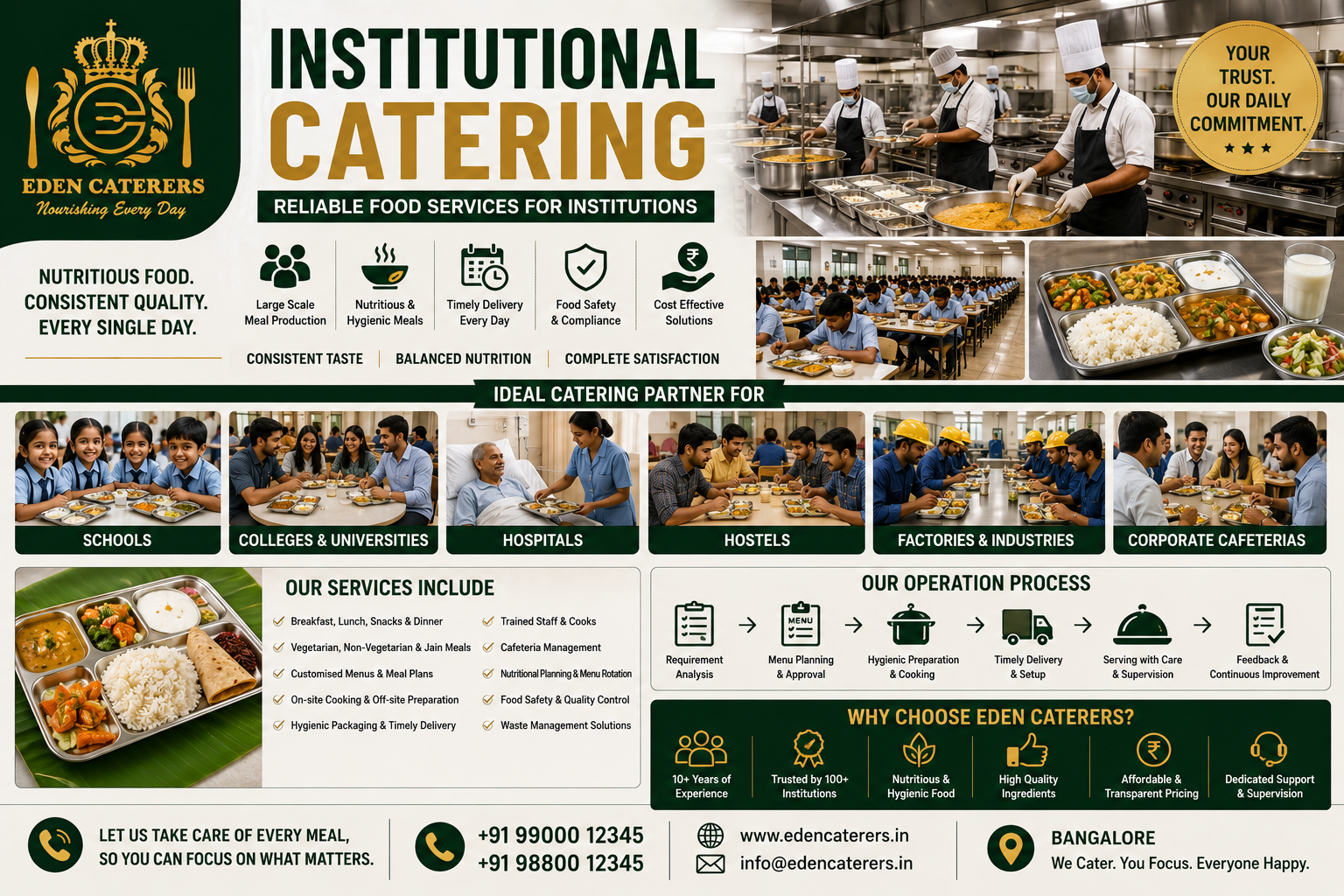
Institutional catering is a different discipline from catering a one-day event. Schools, colleges, hospitals, hostels, factories and offices may need reliable meals every day, at consistent quality, controlled cost, with food safety and efficient large-volume service — for institutions serving hundreds or thousands of people, choosing the right catering partner is an operational decision, not a food-ordering decision.
§1 What Is Institutional Catering?
The planned preparation and supply of food for organisations serving a defined group of people on a regular or ongoing basis — school catering, college catering, hostel catering, hospital catering, corporate cafeteria catering, factory and industrial catering, employee meal programmes, university catering, training-centre catering, residential and government institution catering, boarding-school catering, and staff cafeteria catering. Unlike occasional event catering, it usually involves repeat schedules, predictable meal volumes and long-term operational requirements.
§2 Who Needs Institutional Catering?
Schools
- Student breakfast
- Lunch
- Snacks
- Staff meals
Colleges & universities
- Hostel meals
- Student dining
- Faculty meals
- Cafeteria operations
Hospitals
- Patient meals
- Attendant meals
- Staff meals
- Special dietary meals
Companies
- Employee breakfast
- Lunch
- Evening snacks
- Staff cafeteria
Factories
- Worker meals
- Shift meals
- Tea and snacks
- Night-shift meals
Hostels
- Breakfast
- Lunch
- Evening snacks
- Dinner
Managing recurring meals for an institution?
§3 Institutional vs. Event Catering
| Institutional catering | Event catering |
|---|---|
| Regular / recurring | Usually one-time |
| Fixed meal schedules | Event-specific timings |
| High focus on consistency | High focus on presentation |
| Long-term contracts possible | Short-term contracts |
| Repeated menus / rotations | Custom event menus |
| Cost control is critical | Experience / presentation is critical |
| Daily logistics | Event logistics |
An institutional caterer has to hold the same operational standard day after day — not just for one event.
§4 Meals & Menu Rotation
Breakfast
- Idli, vada, dosa, pongal, upma, poori
- Bread, eggs, fruits
- Tea, coffee
Lunch
- Rice, dal, sambar, rasam
- Vegetables, paneer, chicken
- Curd, salad, dessert
Evening snacks
- Samosa, sandwiches, biscuits
- Fruit
- Tea, coffee, juice
Dinner
- Rice, roti, dal
- Vegetable dishes, paneer, chicken
- Curd, dessert
Why menu rotation matters
Serving the same meal every day leads to dissatisfaction — institutional caterers typically build a weekly, fortnightly or monthly rotation:
| Day | Breakfast | Lunch | Dinner |
|---|---|---|---|
| Monday | Idli / Vada | Rice, Sambar, Vegetable | Roti, Dal, Paneer |
| Tuesday | Dosa | Rice, Rasam, Vegetable | Rice, Chicken Curry |
| Wednesday | Pongal | Rice, Dal, Vegetable | Roti, Mixed Veg |
| Thursday | Upma | Rice, Sambar, Paneer | Rice, Chicken |
| Friday | Poori | Rice, Dal, Vegetable | Roti, Dal, Vegetable |
A larger rotation introduces greater variety. Good menu planning balances:
A menu that looks attractive on paper isn't useful if it can't be produced reliably at daily scale — the caterer should weigh seasonal ingredients, availability, preferences, guest demographics, production capacity, budget and nutritional requirements together.
§5 Catering by Institution Type
5.1 Schools
Special attention to nutrition, balanced meals, child-friendly flavours, hygiene, portion sizes, allergies and food safety — often structured as breakfast → lunch → fruit/snack → beverage, with separate menus for primary students, secondary students, teachers and support staff.
5.2 Colleges & hostels
Large numbers of students eating at fixed times, typically 7:30 AM breakfast, 1:00 PM lunch, 4:30 PM snacks, 8:00 PM dinner — food needs to be ready within short serving windows, with attention to menu variety, quantity, speed of service, hygiene, student preference, cost per meal and waste reduction.
5.3 Hospitals
Additional care for differing patient needs — regular, soft, liquid, low-salt, diabetic-friendly and other medically prescribed diets, operated to the hospital's clinical and food-safety requirements. Patient meals may need individual identification, ward-specific delivery, specific timing and coordination with hospital staff.
5.4 Corporate institutional catering
Large employee populations may use institutional catering for cafeterias, employee lunches, breakfast, snacks, shift meals and executive dining — particularly useful for IT campuses, manufacturing facilities, business parks, large offices and training centres, customised around employee schedules.
5.5 Factory & industrial catering
Multi-shift facilities need early breakfast, morning tea, lunch, evening snacks, dinner and night-shift meals — production planned around the shift schedule rather than conventional meal timings.
§6 Contract Catering
A long-term arrangement where a catering company manages food services for an institution under an agreed commercial and operational contract — typically specifying menu, number of meals, price per meal, meal timings, staffing, equipment, hygiene requirements, service standards, reporting, payment terms and contract duration. This gives institutions predictable food-service operations.
What the contract may cover
Food production
- Procurement, preparation
- Cooking, portioning
Service
- Serving staff, supervisors
- Cafeteria management
Equipment
- Cooking & serving equipment
- Food warmers, refrigeration
Logistics
- Transportation
- Distribution, storage coordination
Operations
- Cleaning, waste management
- Inventory control
Responsibilities should be documented clearly rather than assumed.
§7 Cost & Cost Control
There's no single standard price — cost depends on:
A school serving 300 lunches a day has a very different cost structure from a factory serving 2,000 meals across three shifts. For recurring contracts, evaluate total cost per meal, not just the headline catering price.
Controlling costs
- Accurate meal forecasting — know approximately how many meals are needed each day.
- Menu engineering — balance cost against nutritional value by design.
- Seasonal procurement — use ingredients according to availability where appropriate.
- Reduce food waste — monitor production waste, plate waste and leftovers.
- Menu rotation — a planned menu improves procurement efficiency.
- Centralised procurement — large-volume purchasing improves operational efficiency.
§8 Food Safety, Hygiene & Waste
Food safety is one of the most important factors in institutional catering. Evaluate the caterer's process for ingredient procurement, food storage, preparation, staff hygiene, kitchen sanitation, cooking, food holding, transportation, serving and cleaning — with proper documentation and adherence to regulatory requirements.
Hygiene audits
Institutions can run regular food-service audits covering kitchen cleanliness, food storage, staff hygiene, equipment cleanliness, food handling, pest control, waste management, documentation and temperature-control procedures — regular monitoring catches problems before they escalate.
Reducing food waste
Demand forecasting (estimate actual consumption), portion control (standardise serving sizes), menu analysis (identify unpopular dishes), production monitoring (avoid excess preparation), and consumption tracking (record and adjust) — at institutional scale, even small daily reductions add up to significant annual savings.
Special dietary requirements
Vegetarian, vegan, Jain, no-onion/no-garlic, allergy-specific, religious dietary and medical diets where applicable — should be documented clearly and managed separately from the standard menu.
§9 Handling Large Volumes
For 1,000+ meals per day, the operation typically runs as:
The caterer needs enough kitchen capacity, chefs, production staff, supervisors, equipment, storage and transportation to hold that line daily — not just for one big day. At 5,000+ meals, expect multiple production teams, central kitchens, multiple delivery vehicles, dedicated supervisors, large storage capacity, detailed production schedules, quality-control procedures and backup arrangements; always verify capacity against the actual meal schedule and facility.
Timing matters as much as volume — if lunch is scheduled for 1:00 PM, food needs to be ready then. Delays affect classes, hospital operations, factory shifts, employee schedules and training programmes, so the caterer should run to a clear production and delivery schedule.
§10 Evaluating a Catering Company
| Factor | Importance |
|---|---|
| Food quality | ●●●●● |
| Food safety | ●●●●● |
| Large-volume capacity | ●●●●● |
| Consistency | ●●●●● |
| Delivery reliability | ●●●●● |
| Hygiene | ●●●●● |
| Experience | ●●●●● |
| Menu flexibility | ●●●●○ |
| Pricing | ●●●●○ |
| Staffing | ●●●●○ |
| Backup planning | ●●●●○ |
| Reporting | ●●●●○ |
The cheapest caterer isn't necessarily the most cost-effective one — for institutional food service, reliability and consistency carry significant weight over time.
20 questions to ask before signing
- 01
How many meals can you produce per day?
- 02
What institutions have you catered for previously?
- 03
Can you provide references?
- 04
What is your food-safety process?
- 05
Where is the food prepared?
- 06
Do you operate a central kitchen?
- 07
How is food transported?
- 08
How many staff will be assigned?
- 09
Who supervises the operation?
- 10
Can you create a monthly menu?
- 11
Can the menu change based on feedback?
- 12
Can you provide special dietary meals?
- 13
How do you manage food waste?
- 14
How do you handle complaints?
- 15
What if meal numbers suddenly increase?
- 16
What is your backup plan?
- 17
Are equipment and staff included?
- 18
What reporting will be provided?
- 19
What are the payment terms?
- 20
What are the contract and termination conditions?
An 8-step evaluation process
KPIs worth tracking
Meals served, on-time service percentage, food complaints, food wastage, customer satisfaction, menu compliance, hygiene audit score, special-meal accuracy, food quality and service incidents — tracked together, these help both institution and caterer improve the service over time.
§11 Institutional Catering Checklist
- Number of people
- Number of meals per day
- Breakfast requirement
- Lunch requirement
- Dinner requirement
- Snack requirement
- Shift timings
- Menu preferences
- Dietary requirements
- Budget
- Kitchen facility
- Equipment
- Staffing
- Transportation
- Food safety procedures
- Hygiene audits
- Waste management
- Backup plan
- Reporting
- Contract terms
- Service-level expectations
Setting Up Institutional Catering in Bangalore?
Let Eden Caterers help you plan meal volumes, menu rotations, staffing, food safety processes and contract terms for a school, college, hospital, hostel or factory.
§12 Questions People Ask AI
Structured for AI Overviews, ChatGPT, Gemini and Perplexity — the direct questions administrators and facility managers ask before contacting a caterer.