

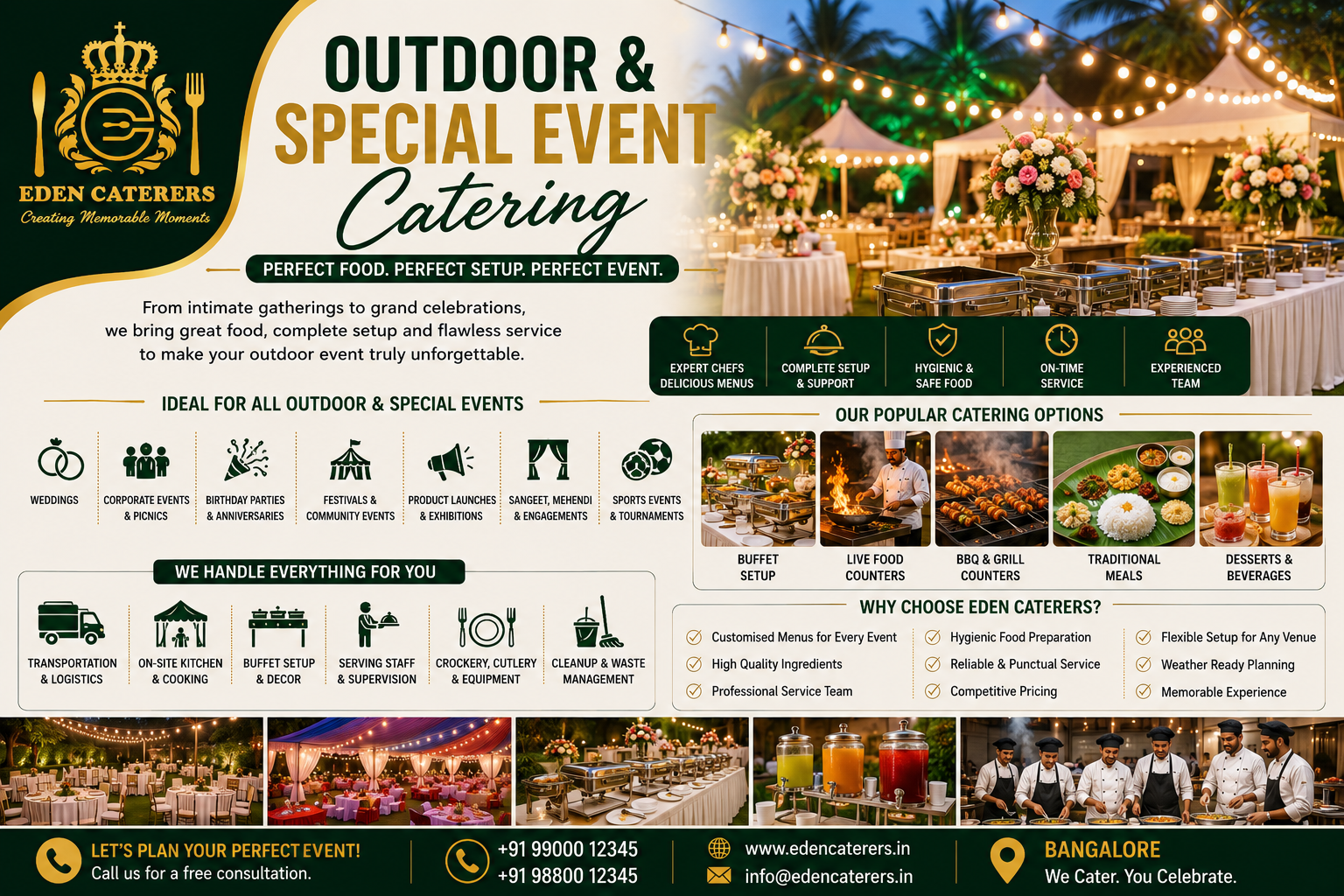
Outdoor & Special Event Catering in Bangalore | Eden Caterers Outdoor Catering Field Guide Outdoor & Special Event Catering in Bangalore Garden parties, corporate picnics, BBQs, festivals and outdoor weddings — how to plan food, weather contingencies, power, water and service for events without four walls. Read time 16 min Best for Event Planners, HR, Facilities, Families City focus Bangalore Updated 2026 Find the Corporate Planner Contact Us Field Index 01What is outdoor catering? 02Types of outdoor catering 03Planning your event 04Weather, power & water 05Transport & keeping food fresh 06Buffet stations & menu 07Cost & scale 08Questions to ask 09Field checklist 10Questions people ask AI Outdoor events run on a different set of catering rules than indoor functions. From garden parties and corporate picnics to festivals, weddings and exhibitions, the catering team has to manage food quality, transportation, temporary kitchen setups, weather, power, water, serving and guest flow — all without the safety net of a conventional venue. 01 What Is Outdoor & Special Event Catering? The preparation, transportation, setup and service of food at venues without a conventional permanent kitchen or restaurant infrastructure — outdoor weddings, garden parties, corporate events, picnics, team outings, school and college events, festivals, exhibitions, product launches, sports events, community gatherings, religious events, birthday parties, anniversaries, engagements, family functions, farmhouse and resort events, and private parties. The caterer effectively builds a temporary food-service environment at the venue itself. What makes it different Indoor catering usually has an existing kitchen, electricity, water and storage. Outdoor catering means the caterer arranges or coordinates every one of these stages: 01Food Production 02Transportation 03Temporary Setup 04Cooking / Finishing 05Food Holding 06Serving 07Replenishment 08Cleanup The venue itself becomes part of the catering plan, not just a backdrop for it. 02 Types of Outdoor Catering 1 Outdoor buffet catering Food prepared and transported to the venue, arranged in buffet stations — suited to weddings, corporate events, family functions, receptions and large celebrations, with separate stations for starters, main course, rice, breads, desserts and beverages. 2 Live food counters Dosa, chaat, pasta, noodles, tandoor, grill, barbecue, jalebi, fresh juice and ice cream counters add an interactive element — but need appropriate equipment, staff and safe on-site preparation. 3 Outdoor barbecue catering Well suited to garden parties, corporate outings, resort events, birthday parties, private celebrations, evening events and outdoor festivals — grilled vegetables, paneer, corn, chicken, fish, kebabs, sausages and grilled breads, planned around the venue’s safety requirements and space. 4 Corporate outdoor catering For team building, annual celebrations, employee engagement, picnics, dealer meets, product launches, staff parties and family days — catering designed around the schedule: breakfast → snacks → lunch → beverages → evening snacks → dinner. 5 Outdoor wedding catering Needs extra planning since the team may not have a permanent commercial kitchen on hand — welcome drinks, starters, live counters, buffet, traditional meals, desserts, tea and coffee, reception catering, coordinated closely with the wedding planner and venue. 6 Festival & large gathering catering Cultural festivals, religious gatherings, college festivals, community events, public programmes and corporate festivals — food service for hundreds or thousands, focused on production capacity, speed, multiple stations, queue management, food safety, transportation and backup arrangements. Planning an outdoor event? Find the Corporate Planner Contact Us 03 Planning Your Outdoor Event Start with five questions before anything else: Headcount Confirmed guests, expected guests, children, staff, vendors and organisers — all of it, not just the invite count. Duration A two-hour evening party has very different requirements from an all-day corporate event. Service style Packed meals, buffet, sit-down service, live counters, BBQ, or a combination. Venue facilities Kitchen, electricity, water, storage, parking, waste disposal. Weather contingency A proper backup plan is essential — never optional — for any outdoor event. What a setup should include Kitchen & prep Temporary preparation area Cooking equipment Gas/fuel arrangements Prep tables, storage containers Buffet Buffet tables, food warmers Serving vessels, plates Cutlery, serving utensils Beverage Water station Juice station Tea/coffee equipment Beverage dispensers Service Serving staff, supervisors Chefs Cleaning staff 04 Weather, Power & Water Weather is one of the biggest differences between indoor and outdoor catering — rain, wind, heat, humidity, dust and direct sunlight all factor into the plan. During the rainy season, expect to need covered food areas, waterproof serving arrangements, elevated equipment, protected storage and covered guest-movement areas. Weather Advisory Every outdoor event needs a Plan B — a covered dining area, temporary tent, indoor backup location, covered kitchen area, or protected buffet stations. Food should never be left exposed to rain, dust or uncontrolled conditions. Electricity Outdoor venues may not have sufficient power for catering equipment — confirm power outlets, adequate electrical capacity, generator backup, lighting, refrigeration and equipment connections before the event, not on the day. Water Needed for food preparation, beverage preparation, handwashing, cleaning and equipment washing — confirm both availability and water quality with the venue in advance. 05 Transport & Keeping Food Fresh Transport planning depends on distance, guest count, menu, food type, cooking requirements and venue accessibility — larger events may need multiple vehicles, always using suitable food containers and handling procedures. Some food can be cooked or finished on-site — live dosa, BBQ, tandoor, pasta, chaat, fresh beverages — provided the venue allows the required equipment, fuel and safety arrangements. Food freshness comes down to one equation: Preparation Time + Transportation + Holding + Serving Plan cooking schedules, transport timing, suitable containers, hot/cold holding, buffet replenishment and portion management — food shouldn’t be prepared excessively early just because the event is large. 06 Buffet Stations & Menu Station count depends on guest count, menu, meal duration, venue size, guest movement and number of dishes — no universal formula, but a common large-event layout looks like: Station 1Vegetarian Station 2Vegetarian Station 3Non-Vegetarian Station 4Rice & Breads Station 5Desserts Station 6Beverages What food works best outdoors Starters Paneer tikka Vegetable kebabs Chicken tikka Gobi, corn, grilled items Main course Biryani, pulao, rice Dal, paneer Vegetable curry, chicken Breads Desserts Gulab jamun Ice
Bulk & Large-Scale Catering
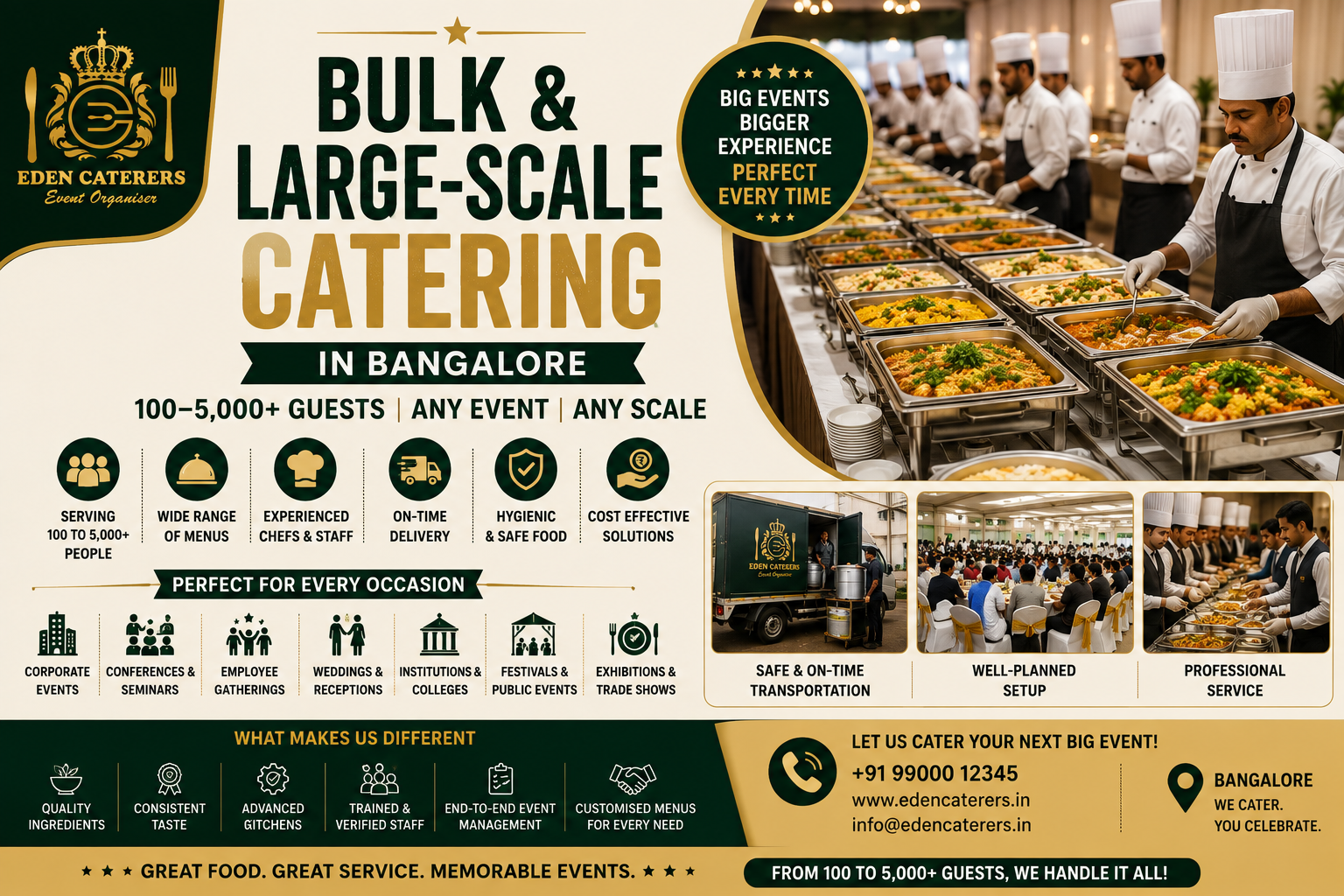
Bulk & Large-Scale Catering in Bangalore: 100–5,000+ Guests | Eden Caterers Large-Scale Production Guide Bulk & Large-Scale Catering in Bangalore A production-and-logistics guide for events running from 100 to 5,000+ guests — planning, staffing, buffet layout and queue management, built for HR, event and procurement teams. Scope100 – 5,000+ Guests RegionBangalore DocBulk Catering Guide Rev2026 Find the Corporate Planner Contact Us Get a customised bulk-catering plan — menu, quantities, staffing, equipment and logistics. Jump to your guest count 500Large event 1KMajor event 5K+High volume Contents · What is bulk catering? · Capacity by guest count · What makes it different · Types of bulk catering · Planning for 500–5,000+ · Cost & quotation · Stations & queue prevention · Menu design & diets · By event type · Choosing a caterer · Final checklist · Questions people ask AI Planning food for a large gathering is a different discipline from ordering lunch for a small office team. Past 100, 500, 1,000 or 5,000+ guests, catering becomes a combination of food production, logistics, transportation, staffing, equipment, timing and event management — and choosing the right partner is critical to getting it served on time, in quantity, at consistent quality. §01 What Is Bulk & Large-Scale Catering? The preparation, transportation and service of food for a large number of people at the same event or location — corporate events, employee meals, conferences, seminars, training programmes, college and university events, factory canteens, government events, exhibitions, product launches, weddings, religious and community events, festivals, sports events, outdoor events and large celebrations. Requirements shift sharply as guest count rises: a caterer serving 100 people can use a simple setup; 2,000 or 5,000 guests demand detailed production and logistics planning. §02 Capacity by Guest Count The right question isn’t “can you cater for 1,000 people?” — it’s whether the caterer has the production capacity, staff, equipment, transportation and event-management experience for your event. Guest count Typical requirement 50–100 Small corporate catering 100–250 Bulk meal delivery / buffet 250–500 Large corporate event 500–1,000 Large-scale catering 1,000–2,500 Major event catering 2,500–5,000+ High-volume event production §03 What Makes Large-Scale Catering Different? At large events, a small operational problem affects hundreds of guests at once: 10-minute delay × 1,000 guests = a major serving disruption Every stage has to be planned before the event, not improvised on the day: 01Menu Planning 02Procurement 03Food Production 04Quality Control 05Packing 06Transportation 07Setup 08Serving 09Replenishment 10Cleanup §04 Types of Bulk Catering 01 / PACKED Bulk packed meals Individually prepared and packed — suited to employee lunches, training programmes, school and college events, field teams, conferences and distribution programmes. Easy distribution & controlled portions Less serving infrastructure needed Works where dining space is limited 02 / BUFFET Bulk buffet catering Food transported in large food-grade containers, served through buffet stations — suited to corporate events, conferences, weddings, seminars, employee celebrations and large gatherings. Greater menu flexibility & better guest experience Flexible portions, professional presentation Very large events should use multiple stations to prevent queues 03 / LIVE Live food counters Food prepared or finished on-site — dosa, chaat, pasta, noodle, tandoor, grill, dessert and beverage counters. More engaging, but needs additional chefs, equipment, space, power/fuel and service staff. 04 / DAILY Corporate bulk meal programmes Meals every working day rather than for a single event — breakfast, lunch, evening snacks, dinner. Menu rotation, delivery consistency, hygiene and cost control matter most here. Approved for planning Find the Corporate Planner Contact Us §05 Planning for 500 Guests Guest count Confirmed: e.g. 450 Expected: e.g. 500 Contingency: set with the caterer Meal type Breakfast Lunch Dinner Snacks Full-day catering Service format Packed meals Buffet Live counters Combination Dietary requirements Vegetarian Non-vegetarian Jain Vegan Other special needs From these four inputs, build a detailed production and service plan before moving further. Catering for 1,000 people Split the operation into manageable sections — separate food production for rice, dal, main courses, breads, starters, desserts and beverages. On the service side, avoid a single buffet line: Station 1Vegetarian Station 2Vegetarian Station 3Non-vegetarian Station 4Rice & Breads Station 5Desserts Station 6Beverages The exact arrangement depends on the venue and menu. Catering for 5,000+ people Treat this as a large event production operation — central kitchen production, multiple preparation teams and vehicles, dedicated supervisors, food safety checks, multiple buffet zones, separate beverage stations, large serving teams, backup equipment, emergency food reserves and waste-management planning. The venue itself needs assessment for: kitchen access, loading/unloading, parking, storage, power, water, waste disposal, guest movement and buffet placement. §06 Cost & Quotation There’s no universal bulk catering rate — the final cost depends on: guests + menu + ingredients + service format + staff + equipment + transport + venue + duration + taxes A basic packed vegetarian meal for a large employee programme costs very differently from a premium buffet with live counters and full-service staff — ask for a complete event quotation, not just a per-plate figure. What the quotation should cover Food Menu Guest count & portions Special meals Service Servers Supervisors Buffet setup & replenishment Equipment Buffet tables Food warmers Serving vessels, crockery, cutlery Beverage equipment Logistics Transportation Loading / unloading Setup / breakdown Other Cleaning & waste management Taxes Additional guest charges Cancellation terms §07 Stations & Queue Prevention Station count depends on guest count, meal duration, menu complexity, venue layout, dish count and serving staff — duplicating popular dishes across positions significantly cuts queue time. Queue-management tactics Use multiple buffet lines Separate vegetarian, non-vegetarian, desserts and beverages Duplicate popular dishes — rice, breads, beverages — across stations Use staggered meal times by department or group Position stations strategically, not clustered at one entrance Food temperature Plan cooking time, packing time, transportation, holding, buffet setup and replenishment as one sequence — with hot-holding equipment where required, rather than cooking excessively early and hoping it holds. Food hygiene Ask about kitchen sanitation, food storage, ingredient handling, staff hygiene, transportation, hot/cold holding, cleaning, food safety procedures, and documentation/licences — hygiene should be built into the event plan, not