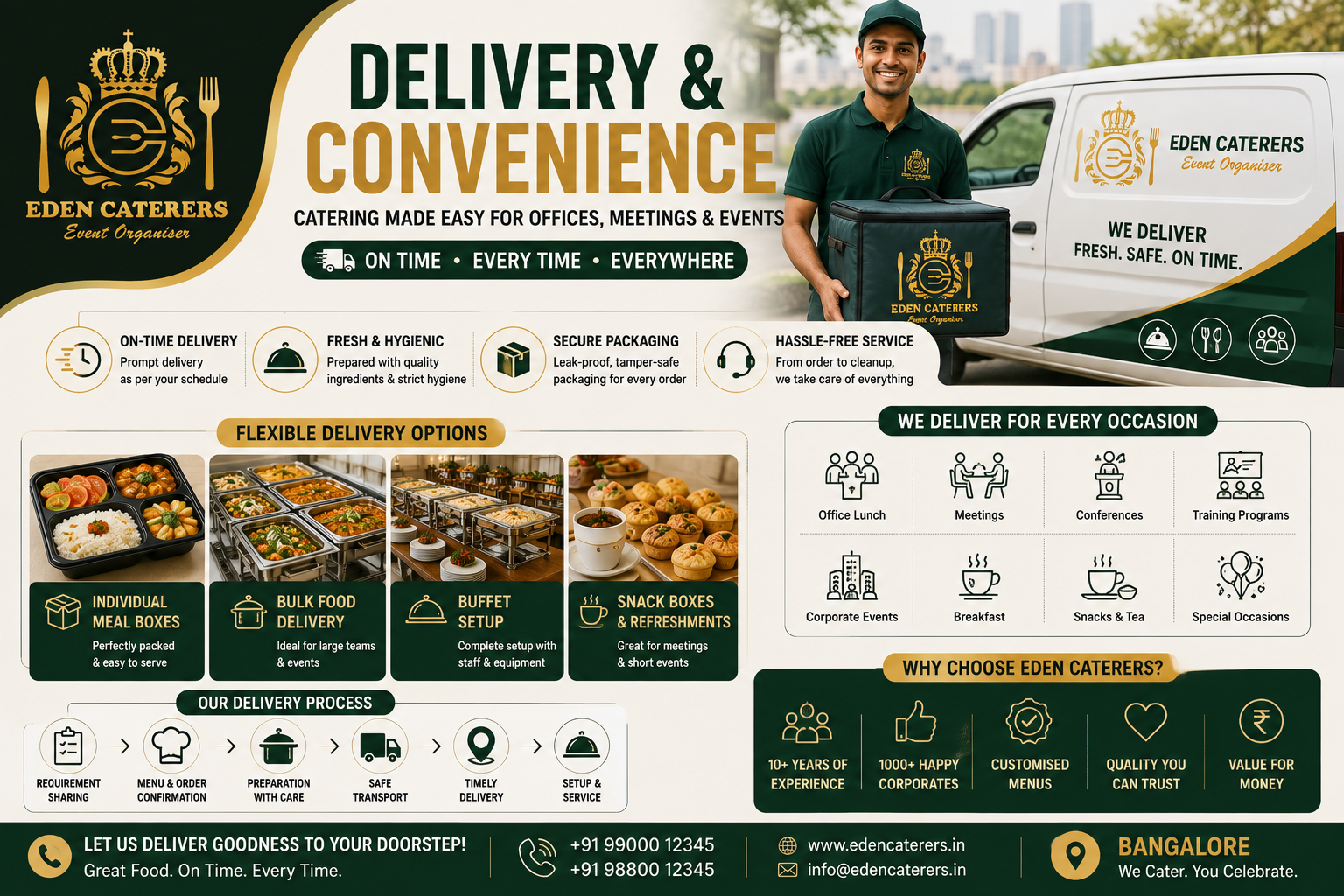
Delivery & Convenience Catering in Bangalore | Eden Caterers Delivery & Logistics Guide Delivery & Convenience Catering in Bangalore Easy food solutions for offices, events and corporate teams — how delivery works, what makes it reliable, and what to ask before you book, for 10 to 1,000+ guests. Read time 15 min Best for HR, Admin, Facilities & Event Teams City focus Bangalore Updated 2026 Catering Delivery Bangalore Office Lunch Bulk Delivery Logistics Find the Corporate Planner Contact Us On this menu · What is delivery & convenience catering? · Types of delivery available · How delivery works, step by step · What makes delivery reliable · Why Bangalore is different · Delivery by group size · Temperature & packaging · What delivery costs · Questions to ask · Delivery checklist · Questions people ask AI When companies organise meetings, employee lunches, training programmes or corporate events, delivery is often the biggest logistical challenge — not whether the food tastes good, but whether it arrives on time, fresh, properly packed, in the right quantity and ready to serve. What Is Delivery & Convenience Catering? Instead of the company managing menu → food preparation → packaging → transportation → setup → serving itself, the caterer manages the entire food logistics chain and delivers according to the agreed schedule. This covers corporate food delivery, office lunch delivery, breakfast delivery, meeting catering delivery, individual meal boxes, bulk meal delivery, snack boxes, corporate event catering, buffet food delivery, beverage delivery and recurring employee meals. For a business, catering is part of the day’s schedule — a delayed lunch can disrupt meetings, training sessions, client appointments, employee schedules, conferences and corporate events. A reliable caterer treats delivery timing as an operational commitment, not simply transportation. What Types of Catering Can Be Delivered? 01 Individual meal boxes Packed separately and delivered to the office — suited to employee lunches, training programmes, business meetings, field teams, conferences and small corporate events. Easy distribution, controlled portions, minimal setup Easy identification, works in limited dining areas 02 Bulk food delivery Delivered in larger food-grade containers for serving at the office or venue — suited to 50–500+ employees, corporate lunches, employee events, regular office meals and large meetings. Reduces individual packaging and gives more flexibility in portions. 03 Breakfast delivery For early meetings, training programmes, workshops, conferences and employee events — idli, vada, dosa, pongal, upma, poori, sandwiches, fruits, tea, coffee, juice. 04 Corporate lunch delivery One of the most common requirements — individual meals (each employee gets a complete meal), bulk meals (delivered in containers, served at office), or buffet catering (delivered and arranged by the catering team). Best option depends on employee count, space and budget. 05 Meeting & conference delivery Catering designed around the meeting schedule, coordinated with the event timetable rather than delivered all at once. 9:00 AMTea & coffee 11:00 AMSnacks 1:00 PMLunch 4:00 PMTea & snacks How Does Corporate Catering Delivery Work? A professional delivery process generally follows ten steps: Step 1Requirement — date, time, location, headcount, menu, dietary needs Step 2Menu confirmation — the caterer finalises menu and quantities Step 3Production — food prepared against the required serving time Step 4Quality check — food, packaging and quantities checked Step 5Packing — meals packed or placed into food-grade containers Step 6Transportation — food transported to the office or venue Step 7Delivery — the team delivers on the agreed schedule Step 8Setup — buffet, serving counters, food warmers, beverage stations, crockery (where included) Step 9Serving — trained staff serve and replenish, for full-service catering Step 10Cleanup — equipment removed and the serving area cleaned (where included) What Makes Catering Delivery Reliable? Preparation time Food prepared with enough buffer to meet the schedule without compromising freshness. Transportation Vehicles and containers suited to transporting prepared food safely. Packaging Protects against spillage, contamination, temperature loss and transport damage. Delivery planning Accounts for traffic, distance, parking, building access, security procedures and loading/unloading — especially important in Bangalore. Why Is Bangalore Different for Catering Delivery? Bangalore’s corporate ecosystem is large and geographically spread — traffic and building-access procedures can meaningfully affect delivery times. A good caterer plans the route and arrival time rather than simply leaving the kitchen at the scheduled serving time. WhitefieldMarathahalliBellandur Outer Ring RoadElectronic CitySarjapur Road KoramangalaHSR LayoutIndiranagar HebbalManyata Tech ParkYelahanka Bannerghatta RoadBommasandraCentral Bangalore How early should catering arrive? Individual meal boxes Should arrive close to the planned eating time. Buffet catering Needs extra time for unloading, setup, food warming, buffet arrangement and final preparation. Meeting catering Tea, snacks and meals coordinated with the meeting schedule — ready when guests need it, not just delivered on the hour. Avoiding delivery problems Before placing an order, share complete access information with the caterer: Share up front Exact office address Building name & floor Meeting room Contact person & phone number Delivery entrance Parking information Security requirements Delivery time & serving time For large offices, the delivery contact should ideally be available when the caterer arrives. Many corporate buildings also have strict security procedures — delivery teams may need visitor registration, ID verification, delivery passes, vehicle registration, loading-area access or lift access, so it helps to inform building security in advance. Individual Boxes vs. Bulk Delivery — and Delivery by Group Size Individual meal boxes Easy distribution Controlled portions Easy for meetings Minimal setup Easy identification, convenient Bulk delivery Flexible portions Less packaging Good for employee lunches Requires a serving area Better for larger groups, often more economical recurring Requirement Recommended option 10–20 person meeting Snack / meal boxes 20–50 employees Individual meals or bulk delivery 50–100 employees Bulk lunch or buffet 100–500 employees Managed bulk catering 500–1,000 employees Large-scale catering + multiple stations 1,000+ guests Full event catering and logistics For 500 employees, expect multiple delivery vehicles where necessary, bulk food containers, multiple serving stations, food-warming equipment, adequate serving staff, a dedicated event supervisor and backup arrangements — treat it as a logistics operation, not a standard food delivery. For 1,000+, the caterer should run production →