

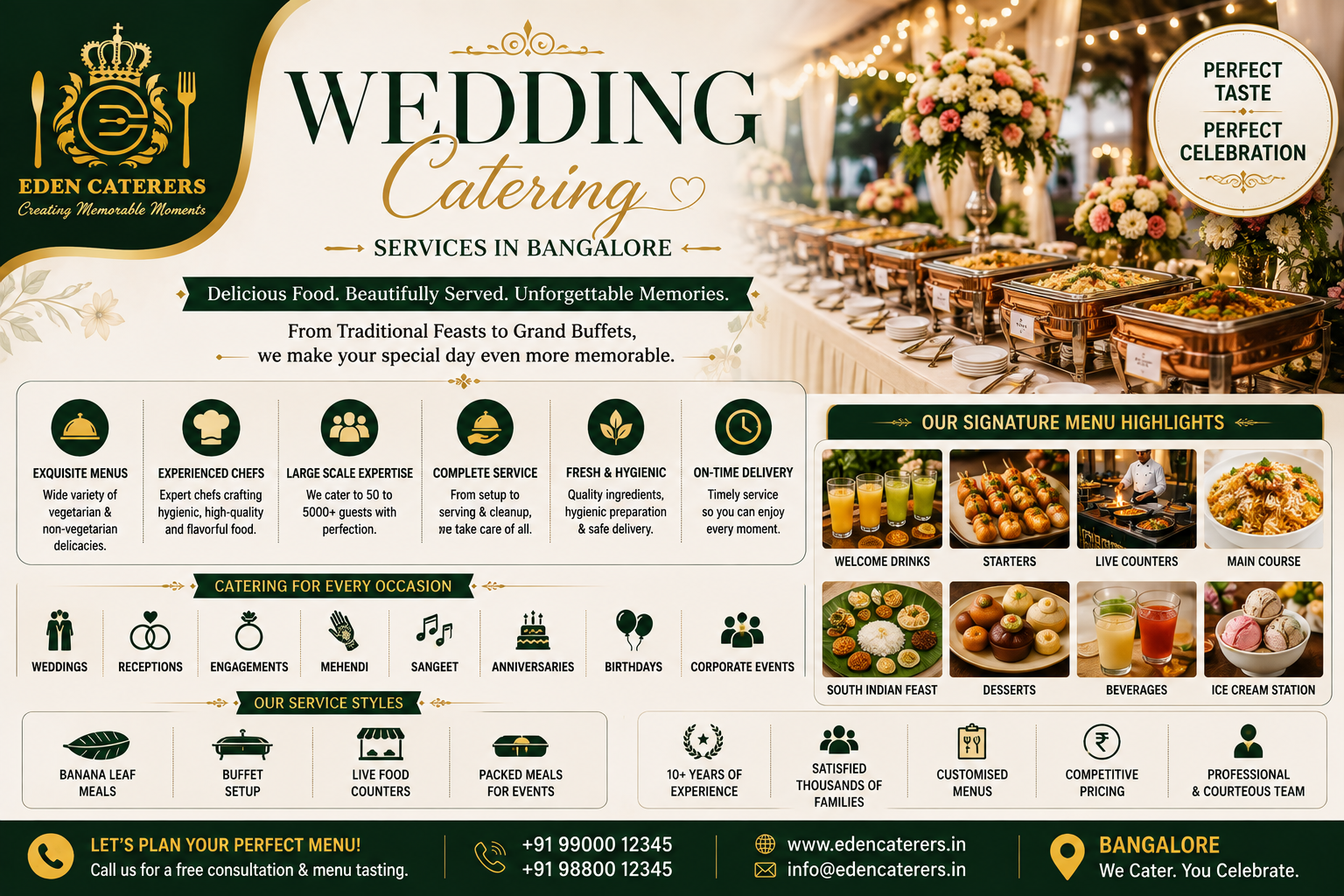
Food is one of the most memorable parts of any wedding. From welcome drinks and starters to the main course, desserts and live counters, wedding catering shapes the entire guest experience — and choosing the right service takes far more than picking a menu.
What Is Wedding Catering?
A complete food and beverage service built around wedding ceremonies and the functions around them — engagement catering, reception catering, traditional wedding meals, buffet catering, banana leaf meals, live food counters, welcome drinks, starters, main course, desserts, wedding breakfast and dinner, mehendi and sangeet catering, and pre- and post-wedding meals. It can range from a simple traditional meal to a large multi-cuisine buffet with several live counters.
Why it matters so much
Guests may forget the decorations, but they remember the food. Good wedding catering delivers:
A single catering problem can affect the whole event — food running out disappoints guests, long queues create frustration, late service disrupts the schedule, poor presentation dulls the experience, and thin staffing makes buffet service difficult. Catering deserves to be planned alongside the venue and event schedule, not after it.
Types of Wedding Catering
-
I.
Traditional South Indian wedding catering
A complete vegetarian meal served on a banana leaf — payasam, sweet, salt, pickle, kosambari, vegetable preparations, sambar, rasam, dal, rice, curd, papad and banana, customised to family and regional tradition.
-
II.
Buffet wedding catering
Multiple dishes for guests to choose from — starters like paneer tikka, gobi, vegetable kebabs, chicken and fish starters; mains spanning rice, biryani, roti, naan, dal, paneer, vegetable curry, chicken and mutton; desserts from gulab jamun to rasmalai, kheer, halwa, cakes and Indian sweets. Well suited to receptions and larger celebrations wanting variety.
-
III.
Live food counters
Dosa, chaat, pasta, noodle, tandoor, grill, jalebi, ice cream, dessert and fresh juice counters make the meal interactive — plan them around available space and expected guest flow.
-
IV.
Multi-cuisine wedding catering
South Indian + North Indian + Chinese + Continental, for modern weddings wanting range. The goal isn't more dishes — it's a menu the catering team can execute at consistent quality across every cuisine.
-
V.
Wedding breakfast catering
For morning ceremonies — idli, vada, dosa, pongal, upma, poori, sambar, chutney, kesari, tea, coffee, fresh juice. Often an important part of the overall traditional wedding plan.
-
VI.
Wedding reception catering
Often the most elaborate — welcome drinks (fresh juices, mocktails, lemon drinks, buttermilk), vegetarian and non-vegetarian starters, a full main course, and desserts including live dessert counters.
Planning your wedding menu?
Guest Capacity & Cost
Choose your caterer based on actual event capacity, not just the length of the menu.
| Guests | Typical requirement |
|---|---|
| 50–100 | Small wedding / intimate event |
| 100–250 | Medium wedding |
| 250–500 | Large wedding |
| 500–1,000 | Large-scale wedding |
| 1,000–2,500 | Major wedding |
| 2,500+ | Mass wedding / event catering |
For large weddings, multiple buffet stations and sufficient serving staff matter more than menu length.
What it costs
Prices vary considerably — the final figure depends on:
A simple traditional meal costs very differently from a premium multi-cuisine buffet with live counters. Don't compare quotations on price per plate alone — check exactly what's included.
What a quotation should cover
Food
- Starters, main course
- Desserts, beverages
- Special dishes
Service
- Serving staff, supervisors
- Buffet setup & replenishment
Equipment
- Buffet tables, food warmers
- Serving equipment, crockery, cutlery
Additional
- Live & beverage counters
- Food-station decoration, cleanup
Commercial terms
- Per-plate price, guest count
- Taxes, advance payment, cancellation terms
Buffet or Traditional Banana Leaf Meal?
Buffet
- More menu variety
- Guests choose their own portions
- Suited to receptions
- Flexible cuisine, multiple stations possible
Traditional meal
- Traditional, structured experience
- Popular for traditional weddings
- Strong cultural identity
- Efficient when well organised
Neither is universally better — the right choice depends on the wedding style and family preferences.
Buffet Counters & Preventing Queues
Station count depends on guest count, meal duration, venue layout, menu, dish count and guest movement. For a large wedding:
The exact arrangement should be designed around the venue. To prevent long queues: use multiple buffet stations rather than one long line, separate vegetarian, non-vegetarian, dessert and beverage categories, duplicate popular dishes across more than one station, and coordinate meal timing with the ceremony and reception programme.
Food hygiene
Ask about kitchen hygiene, ingredient storage, food preparation, staff hygiene, transportation, food holding, serving procedures, cleaning and applicable food safety licences — large weddings need particularly careful handling since many guests are served within a short window.
Considering Every Guest
For children
- Mini pizzas, French fries
- Pasta, sandwiches, noodles
- Mild rice dishes
- Ice cream, mini desserts
A separate children's section can help at large family weddings.
For elderly guests
- Less spicy, traditional dishes
- Soft foods, simple rice dishes
- Curd, fruits
- Warm beverages
Familiar dishes alongside elaborate options make the menu more inclusive.
Presentation & staff
Wedding food is part of the visual experience — attractive buffet counters, elegant serving vessels, live counters, dessert displays, beverage stations, menu signage and professional staff uniforms should all complement the wedding theme. Behind that presentation, a large wedding needs enough staff for buffet management, replenishment, table and beverage service, guest assistance, cleaning and kitchen operations — allocated to guest count and service format, not guessed at.
Choosing Your Caterer
Large wedding catering should be planned well ahead of the event — early planning gives the caterer time for menu design, tasting, ingredient procurement, staffing, equipment, transportation, buffet design and venue coordination, and can help secure your preferred team on a popular date.
Always ask for a food tasting — ideally of the complete proposed menu, not individual dishes tasted at random — to evaluate taste, spice levels, portion sizes, presentation, dessert quality and how the combinations work together.
15 questions to ask a wedding caterer
- 1.
How many weddings have you catered?
- 2.
What is the largest wedding you have handled?
- 3.
Can we customise the menu?
- 4.
Can we conduct a food tasting?
- 5.
Do you provide vegetarian and non-vegetarian menus?
- 6.
Can you provide Jain or vegan food?
- 7.
How many serving staff will you provide?
- 8.
How many buffet counters will you set up?
- 9.
Are live counters available?
- 10.
Is crockery included?
- 11.
Is buffet equipment included?
- 12.
Is cleanup included?
- 13.
Is transportation included?
- 14.
What happens if guest numbers increase?
- 15.
Who will supervise catering on the wedding day?
Wedding Catering Checklist
Before confirming your caterer / 24 checks
- Wedding date
- Venue
- Guest count
- Expected additional guests
- Meal timings
- Cuisine
- Starters
- Main course
- Desserts
- Beverages
- Live counters
- Special dietary meals
- Buffet layout
- Serving staff
- Crockery
- Cutlery
- Food warmers
- Transportation
- Setup
- Cleanup
- Food tasting
- Final quotation
- Payment terms
- Event-day supervisor
Planning a Wedding in Bangalore?
Let Eden Caterers help you plan the menu, quantities, buffet setup, live counters, staffing and complete food service for your special day.
Questions People Ask AI
Structured for AI Overviews, ChatGPT, Gemini and Perplexity — the direct menu, cost and planning questions couples and families ask before contacting a caterer.