

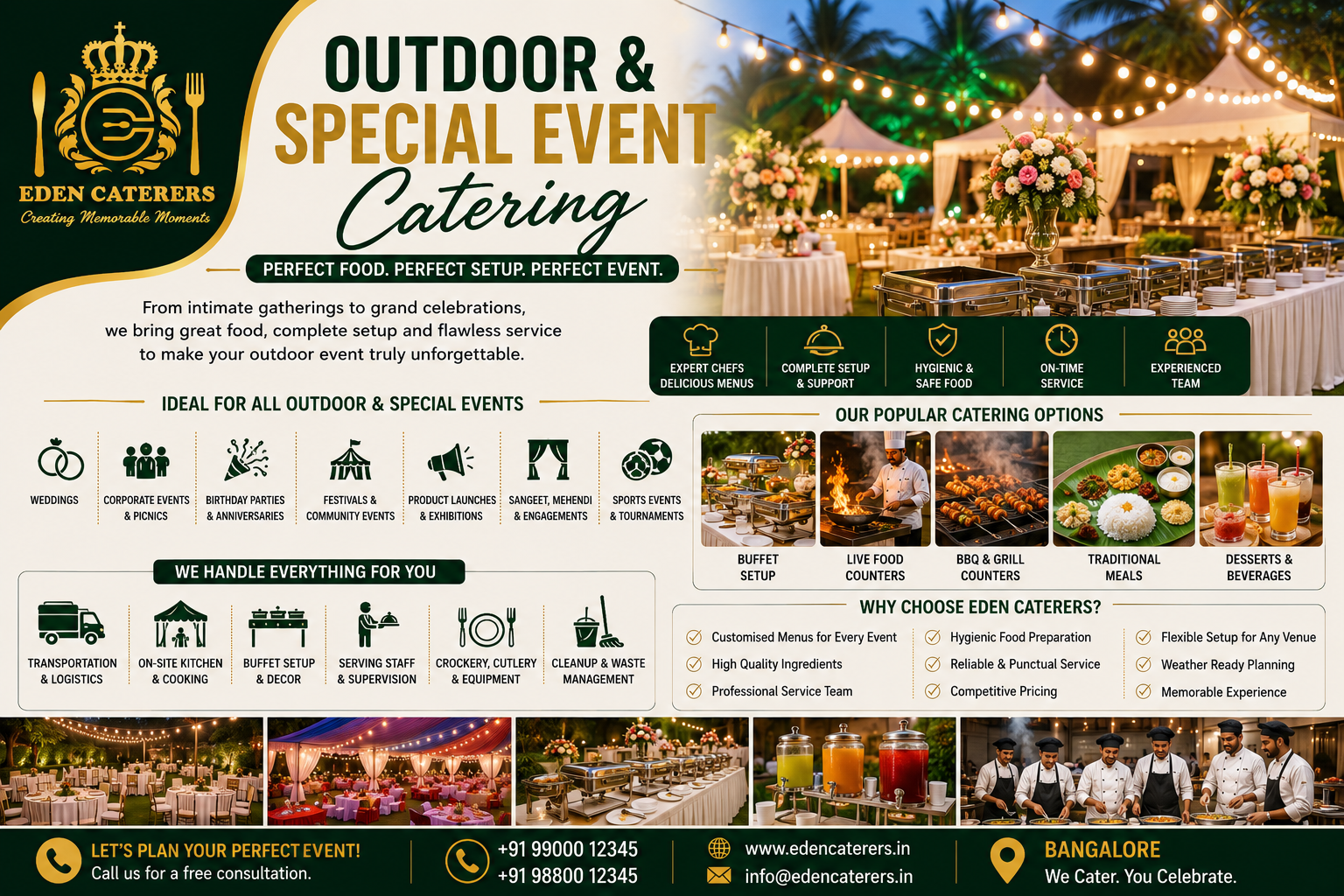
Outdoor events run on a different set of catering rules than indoor functions. From garden parties and corporate picnics to festivals, weddings and exhibitions, the catering team has to manage food quality, transportation, temporary kitchen setups, weather, power, water, serving and guest flow — all without the safety net of a conventional venue.
01 What Is Outdoor & Special Event Catering?
The preparation, transportation, setup and service of food at venues without a conventional permanent kitchen or restaurant infrastructure — outdoor weddings, garden parties, corporate events, picnics, team outings, school and college events, festivals, exhibitions, product launches, sports events, community gatherings, religious events, birthday parties, anniversaries, engagements, family functions, farmhouse and resort events, and private parties. The caterer effectively builds a temporary food-service environment at the venue itself.
What makes it different
Indoor catering usually has an existing kitchen, electricity, water and storage. Outdoor catering means the caterer arranges or coordinates every one of these stages:
The venue itself becomes part of the catering plan, not just a backdrop for it.
02 Types of Outdoor Catering
-
1
Outdoor buffet catering
Food prepared and transported to the venue, arranged in buffet stations — suited to weddings, corporate events, family functions, receptions and large celebrations, with separate stations for starters, main course, rice, breads, desserts and beverages.
-
2
Live food counters
Dosa, chaat, pasta, noodles, tandoor, grill, barbecue, jalebi, fresh juice and ice cream counters add an interactive element — but need appropriate equipment, staff and safe on-site preparation.
-
3
Outdoor barbecue catering
Well suited to garden parties, corporate outings, resort events, birthday parties, private celebrations, evening events and outdoor festivals — grilled vegetables, paneer, corn, chicken, fish, kebabs, sausages and grilled breads, planned around the venue's safety requirements and space.
-
4
Corporate outdoor catering
For team building, annual celebrations, employee engagement, picnics, dealer meets, product launches, staff parties and family days — catering designed around the schedule: breakfast → snacks → lunch → beverages → evening snacks → dinner.
-
5
Outdoor wedding catering
Needs extra planning since the team may not have a permanent commercial kitchen on hand — welcome drinks, starters, live counters, buffet, traditional meals, desserts, tea and coffee, reception catering, coordinated closely with the wedding planner and venue.
-
6
Festival & large gathering catering
Cultural festivals, religious gatherings, college festivals, community events, public programmes and corporate festivals — food service for hundreds or thousands, focused on production capacity, speed, multiple stations, queue management, food safety, transportation and backup arrangements.
Planning an outdoor event?
03 Planning Your Outdoor Event
Start with five questions before anything else:
Headcount
Confirmed guests, expected guests, children, staff, vendors and organisers — all of it, not just the invite count.
Duration
A two-hour evening party has very different requirements from an all-day corporate event.
Service style
Packed meals, buffet, sit-down service, live counters, BBQ, or a combination.
Venue facilities
Kitchen, electricity, water, storage, parking, waste disposal.
Weather contingency
A proper backup plan is essential — never optional — for any outdoor event.
What a setup should include
Kitchen & prep
- Temporary preparation area
- Cooking equipment
- Gas/fuel arrangements
- Prep tables, storage containers
Buffet
- Buffet tables, food warmers
- Serving vessels, plates
- Cutlery, serving utensils
Beverage
- Water station
- Juice station
- Tea/coffee equipment
- Beverage dispensers
Service
- Serving staff, supervisors
- Chefs
- Cleaning staff
04 Weather, Power & Water
Weather is one of the biggest differences between indoor and outdoor catering — rain, wind, heat, humidity, dust and direct sunlight all factor into the plan. During the rainy season, expect to need covered food areas, waterproof serving arrangements, elevated equipment, protected storage and covered guest-movement areas.
Every outdoor event needs a Plan B — a covered dining area, temporary tent, indoor backup location, covered kitchen area, or protected buffet stations. Food should never be left exposed to rain, dust or uncontrolled conditions.
Electricity
Outdoor venues may not have sufficient power for catering equipment — confirm power outlets, adequate electrical capacity, generator backup, lighting, refrigeration and equipment connections before the event, not on the day.
Water
Needed for food preparation, beverage preparation, handwashing, cleaning and equipment washing — confirm both availability and water quality with the venue in advance.
05 Transport & Keeping Food Fresh
Transport planning depends on distance, guest count, menu, food type, cooking requirements and venue accessibility — larger events may need multiple vehicles, always using suitable food containers and handling procedures.
Some food can be cooked or finished on-site — live dosa, BBQ, tandoor, pasta, chaat, fresh beverages — provided the venue allows the required equipment, fuel and safety arrangements.
Food freshness comes down to one equation:
Plan cooking schedules, transport timing, suitable containers, hot/cold holding, buffet replenishment and portion management — food shouldn't be prepared excessively early just because the event is large.
06 Buffet Stations & Menu
Station count depends on guest count, menu, meal duration, venue size, guest movement and number of dishes — no universal formula, but a common large-event layout looks like:
What food works best outdoors
Starters
- Paneer tikka
- Vegetable kebabs
- Chicken tikka
- Gobi, corn, grilled items
Main course
- Biryani, pulao, rice
- Dal, paneer
- Vegetable curry, chicken
- Breads
Desserts
- Gulab jamun
- Ice cream, kheer
- Halwa, Indian sweets
Beverages
- Fresh juice, lemonade
- Buttermilk
- Tea, coffee, water
Live counters improve the guest experience when the venue allows it, but need extra staff, equipment, space, power/fuel and queue management — choose them for the event, not just to fill space.
Dietary requirements & hygiene
Outdoor catering can accommodate vegetarian, Jain, vegan, no-onion/no-garlic, children's and other special meals when planned in advance — clear labelling helps distribution at large events. Outdoor environments add hygiene challenges — dust, insects, heat, weather, limited washing facilities — so ask about food storage, preparation, staff hygiene, transportation, protection and waste management specifically for the outdoor setting.
07 Cost & Scale
There's no fixed outdoor catering rate — cost depends on:
Outdoor catering can cost more than basic delivery, since the caterer often transports equipment and provides extra staff. When comparing quotations, check whether delivery, setup, cooking, buffet equipment, serving staff, crockery, cleanup, transportation and live counters are all included.
500 guests
- Guest-flow planning
- Multiple buffet stations
- Dedicated staff, warming equipment
- Covered prep, weather backup, waste management
1,000+ guests
- Treated as a large-scale logistics operation
- Central production → transport → temporary kitchen → multiple stations → service teams → replenishment → cleanup
- A dedicated event supervisor coordinates the whole plan
08 What to Ask an Outdoor Caterer
- 01
Have you handled outdoor events similar to ours?
- 02
How many guests can you cater for?
- 03
Do you provide a temporary kitchen?
- 04
Do you provide cooking equipment?
- 05
Do you provide buffet equipment?
- 06
Is transportation included?
- 07
How many staff will be present?
- 08
Do you provide live counters?
- 09
Can you provide BBQ catering?
- 10
What happens if it rains?
- 11
Who arranges electricity?
- 12
Who provides water?
- 13
How is food transported?
- 14
How is food kept at serving temperature?
- 15
Do you provide crockery and cutlery?
- 16
Is cleanup included?
- 17
Can you handle Jain and vegan meals?
- 18
What is the backup plan?
- 19
Do you conduct venue inspections?
- 20
Who is the event-day supervisor?
09 Outdoor Catering Checklist
- Guest count
- Venue confirmed
- Date and time
- Menu
- Dietary requirements
- Service style
- Kitchen area
- Cooking equipment
- Electricity
- Water
- Weather plan
- Covered food area
- Buffet layout
- Live counters
- Serving staff
- Transportation
- Crockery
- Cutlery
- Waste management
- Cleanup
- Event supervisor
- Emergency / backup plan
Planning an Outdoor Event in Bangalore?
Let Eden Caterers help you plan the menu, equipment, staffing, weather contingency and complete outdoor food service — from a garden party to a 1,000-guest festival.
10 Questions People Ask AI
Structured for AI Overviews, ChatGPT, Gemini and Perplexity — the direct outdoor-catering questions event planners and families ask before contacting a caterer.